
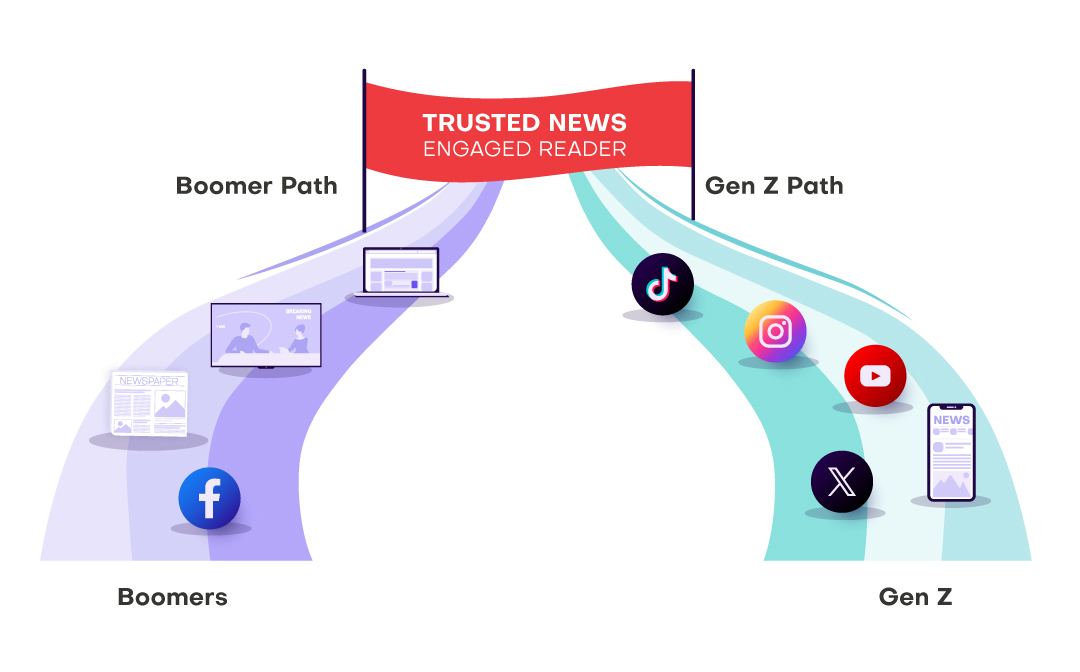
Reaching baby boomers and Generation Z simultaneously is like coaching sprinters and marathoners to run the same race. They move at different speeds and favor different routes: 78% of Boomers still get news from TV and over half read print newspapers, while 84% of Gen Z turn to social media and only 26% watch TV news. Both are key audiences — Boomers bring spending power and loyalty, Gen Z brings the future. The challenge is to keep both in the race, using fresh platforms and styles for younger readers while maintaining the trust and formats older readers value. Leading publishers in the U.S. and Europe are already making that happen and, for media leaders, taking an assessment of exactly how can keep the positive momentum and the money flowing.
How can platform diversification help create cross-generation appeal?
One key strategy? Platform diversification — basically, being everywhere your readers are. Boomers used to get news from the morning paper or the 6 o’clock news, and many still do. But their habits are shifting fast: Boomers’ digital media use has jumped from about 32% to 53% over the last decade. Now, 35% check news websites or apps daily, and over half stream online videos. They’re on social media too — 43% say Facebook is their main spot — but they don’t use social media as much as Gen Z.
Gen Z gets news online, mostly through feeds and videos. Worldwide, 38% of Gen Z use TikTok for news, and most prefer Instagram, YouTube, and other social channels over traditional sources.
Publishers are maintaining print, desktop, and TV content for Boomers while expanding mobile apps, podcasts, newsletters, and social media for younger audiences. TikTok is especially popular. The Washington Post quickly gained over 640k TikTok followers by mixing news with a playful, fresh approach. ABC News, meanwhile, turned to short, direct TikTok videos to reach younger viewers. They kept the videos in alignment with their mission but very focused on the needs and attention of their Gen Z audience.
Platform diversification keeps Boomers comfortable while meeting Gen Z where they already spend time.
How can personalization help media leaders straddle generations?
Audiences, especially younger readers, used to highly personalized social media feeds, expect content that reflects their interests. And publishers are meeting this demand with data-driven customization. The New York Times app, for example, introduced a “You” tab, allowing readers to choose topics and receive tailored feeds. There are also curated audio and games alongside news. Other outlets tailor email newsletters by audience — older readers might get updates on home improvement and investing, while younger readers see content on tech trends or social causes. This approach delivers relevant content without altering the publisher’s overall voice and keeps each group engaged without cluttering the main site.
Content formats are personalized as well: mobile-friendly briefs and Instagram Stories serve on-the-go readers, while older audiences often prefer long-form articles, print, or larger fonts. By aligning content with individual preferences, publishers build loyalty and strengthen trust in their offerings.
How can each generation’s language & tone be leveraged?
Tone and language play a major role in appealing across generations. Baby Boomers grew up with formal, authoritative journalism and often still prefer straightforward, serious coverage, whereas Gen Z tends to favor media that feels approachable, genuine, and even playful. Publishers need to adjust tone and content without losing their core identity.
Authenticity matters most for younger audiences: “Just be authentic. [Gen Z] can smell B.S. … an overproduced video with an agenda a mile away, and they’re not into it,” notes one audience director. To connect, publishers often adopt a conversational, relatable style that may include humor, but it must feel real. The Washington Post’s TikTok presence is a prime example: producer Dave Jorgenson leans into self-deprecating, “dad joke” humor, embracing his own quirky personality, while still linking back to serious reporting.
What can transcend language and tone?
Engaging content resonates across age groups. Readers of all ages appreciate personality, relevance, and coverage that reflects their lives. Outlets that expand into tech, climate, and pop culture using younger journalists can attract Gen Z without losing older readers, who enjoy staying connected to trends. The Orlando Sentinel’s extreme sports page, intended for teens, ended up being most popular with readers 55 and older, revealing its broad appeal.
Additionally, in life and publishing, one of the best ways to bring disparate groups to the same goal is to build community. News brings people together. Boomers liked to talk about the news by the proverbial watercooler or at lunch during work. Gen Z likes to comment on social media to connect over news and justice causes. Many outlets work hard to appeal to Boomers who like publishing sites and can remain silent online by keeping moderated comment sections for older readers and active social channels for younger ones — e.g., Facebook Live Q&As for older audiences, Reddit or Twitter Spaces for Gen Z and millennials.
Interactive and user-generated content boosts engagement. The Washington Post’s TikTok haiku challenge drew thousands of young participants, while games like the NY Times Crossword and Wordle offer shared, multigenerational experiences.
Publishers must avoid condescension toward any group. Gen Z enjoys short, engaging media but also reads long-form journalism on topics they care about. Boomers welcome thoughtful innovation rather than stale reporting. Including diverse voices in the newsroom, particularly young staff, helps shape content that appeals to Gen Z while maintaining credibility for older readers.
How does trust and credibility play a part?
Both Boomers and Gen Z prioritize trustworthy news, but they approach it differently. A 2025 survey found 65% of Gen Z often question story accuracy, compared with 55% of Boomers. Growing up amid “fake news,” social media misinformation, and partisan commentary, Gen Z tends to be skeptical of traditional authority, with only 11% trusting TV news anchors versus 36% of Boomers. However, Boomers are quicker to reject outlets they perceive as biased — 36% would stop reading a source misaligned with their values, compared with 15% of Gen Z.
For publishers, credibility is essential. While a strong brand influences trust for 39% of Americans, younger audiences value authenticity and transparency. Strategies include factual reporting, acknowledging mistakes, and behind-the-scenes explanations. Representation also matters: Gen Z and young millennials notice inclusive coverage and diverse perspectives.
Nurturing both groups to the finish line — news engagement — involves the strategies discussed in this post. Younger generations are unlikely to adopt traditional news habits simply with age — publishers need to reach them now, using approaches that match their preferences and keep their trust. At the same time, long-standing older readers should be valued, well-served, and seen for the ways they too are evolving, since their loyalty and financial support create the stability needed for innovation.